In “The Message,” Ta-Nehisi Coates delivers a fiery secular sermon
Share
Explore Our Galleries









Breaking News!
Today's news and culture by Black and other reporters in the Black and mainstream media.
Ways to Support ABHM?
By Victor Ray, The Emancipator
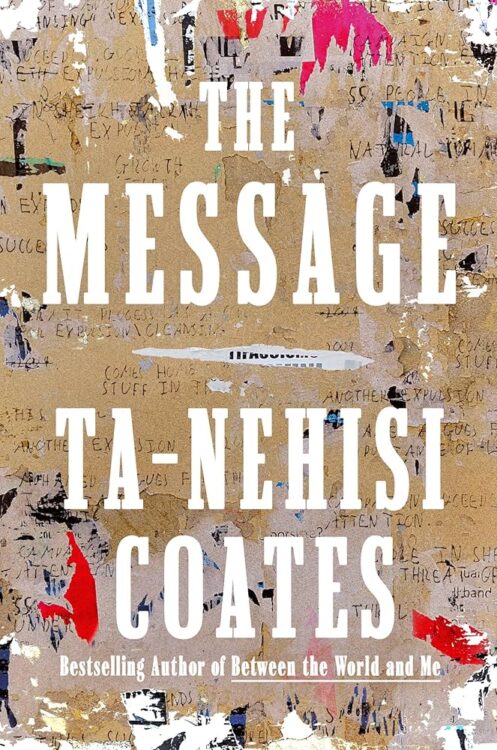
Ta-Nehisi Coates, one of America’s most celebrated public intellectuals, at the height of his renown, retreated from the public eye to focus on writing novels and comic books. With “The Message,” Coates returns to his nonfiction roots, which is likely to be one of the most consequential books of the year. The book is filled with the beautiful sentences we have come to expect from Coates, turns of phrase that James Baldwin would call “as clean as a bone.” However, Coates’s artistry is likely not enough to dislodge entrenched political positions, and responses to the book are already refracted through preexisting understanding of the Israel/Palestine conflict, the subject of the book’s final essay. In centering Palestinian suffering, Coates incinerates some of his accrued cultural capital, almost in penance, to make his case.
Coates is an atheist. Yet “The Message” — from its title through the central essay — repeatedly invokes religious imagery and feeling. He takes on the tone and cadence of the pulpit, documenting a war between what he perceives as evil and its inverse while creating a looming sense of catastrophic judgment (and a requisite, flickering hope of redemption). Ideas hit Coates as “revelations,” belying the reporting and careful study that shape the text. South Carolina book banners, attempting to shape curriculum in their image, are “bearing the flaming cross” of a corrupted Christianity that worships Whiteness. Also, journalists who use objectivity as a cover for biased pro-Israel coverage are “playing god.” An atheist adopting the mantle of the moral bard may seem paradoxical, but the essays in “The Message” show religion often holds a central place in the self-justifying myths of the powerful.
Part of the religious undertone in Coates’ writing is inherited from his chosen intellectual lineage. He self-consciously modeled the writing in “Between the World and Me” on son-of-a-preacher James Baldwin’s work, and the many scribes of the Civil Rights Movement who brilliantly used prophetic language on their march towards freedom. The Black Radical Tradition is filled with church people. However, Coates is too deliberate a writer to adopt pious language stylistically, or simply through inertia. “The Message” faces some of the central moral questions of our time — colonialism’s legacies and ongoing horrors, fights over teaching accurate history to shape the future, and Israel’s ongoing occupation of Palestine. Coates claims writing should contribute to an “emancipatory mandate,” and sees the writer’s task as nothing short of “doing our part to save the world.” Since the sanitized language of scholarship often fails to capture an individual human’s singular irreplaceability, Coates reaches for the transcendent language of certitude and moral clarity offered by faith. Coates’ decision to challenge a murderous foreign policy consensus echoes Dr. King’s famous 1967 “Beyond Vietnam” speech at Harlem’s Riverside Church, which tied American foreign policy to domestic racism. Following this speech, many of Dr. King’s liberal supporters abandoned him, arguing that King’s critique lacked nuance and knowledge.
Coates applies the Black prophetic tradition’s fiery condemnation of hypocrisy to the mainstream media’s purportedly objective reporting on the Israel/Palestine conflict. Coverage of the conflict often fails on the media’s own terms, as neutral-seeming journalistic descriptions of Israeli policy are often thin justifications for said policy. Journalism’s righteous commitment to truth, a motivation that drew Coates to writing, is betrayed when American media’s tacit support for Israel’s contemporary policy towards Palestinians reveres “factual complexity over self-evident morality.” American journalism generally recognizes and occasionally condemns the self-evident evil in our overthrown apartheid system. Yet the simple conclusions that follow from condemning Jim Crow at home — that segregation is a sin that debases individuals and corrupts the state — are not extended to Palestinians.
The Emancipator has more.
Coates isn’t the first Black activist to speak up for Palestine.
More breaking news here.
Comments Are Welcome
Note: We moderate submissions in order to create a space for meaningful dialogue, a space where museum visitors – adults and youth –– can exchange informed, thoughtful, and relevant comments that add value to our exhibits.
Racial slurs, personal attacks, obscenity, profanity, and SHOUTING do not meet the above standard. Such comments are posted in the exhibit Hateful Speech. Commercial promotions, impersonations, and incoherent comments likewise fail to meet our goals, so will not be posted. Submissions longer than 120 words will be shortened.
See our full Comments Policy here.