OPINION: The Next Battle Over Colorblindness Has Begun
Share
Explore Our Galleries









Breaking News!
Today's news and culture by Black and other reporters in the Black and mainstream media.
Ways to Support ABHM?
Sonja B. Starr, The New York Times
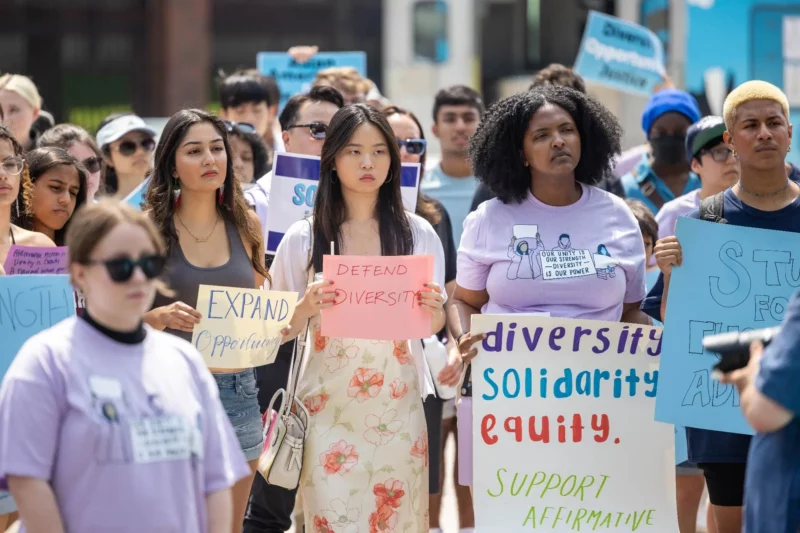
Last month the Supreme Court sharply curtailed the use of race-based affirmative action in higher education. That’s a big deal, but it’s by no means the end of the campaign to eliminate race-conscious policies in education and elsewhere. Indeed, it’s just the beginning. […]
But less appreciated is the impact that this legal battle could have beyond school admissions. Race gaps characterize nearly every dimension of U.S. life: life expectancy, maternal mortality, employment rates, income, wealth, environmental exposures, criminal justice involvement and many others. Policymakers routinely seek to close these gaps, even when debating policies that aren’t directly about race, such as environmental regulations, health policy and criminal justice reform.
These legal cases represent a potential revolution that would severely constrain efforts to reduce racial disparities or promote integration. If courts were to accept the plaintiffs’ extreme vision of colorblindness, policymakers would be presented with an untenable choice: either not to pursue these goals at all — or to address them only surreptitiously, by masking their intentions. […]
When the government (or an entity that receives federal funds, like a school) treats individuals differently based on race, it must overcome a demanding legal test called strict scrutiny. Until last month, the Supreme Court had, within limits and begrudgingly, said that university-level affirmative action passed this test. Going forward, it will be nearly impossible for affirmative action policies to do so.
But the Supreme Court has long condoned policies that don’t entail classifying individuals by race, even if the goal of the policy is race-conscious. For example, incorporating geographic or socioeconomic preferences into a college’s admissions policy has never been considered constitutionally suspect, even if the college is doing it in part to promote racial diversity. Traditionally, when a policy’s language and implementation are race-neutral but its goals are race-conscious, courts apply strict scrutiny only when those goals are invidious — promoting racial disparity rather than fighting it.
Eliminating the distinction between means and ends would threaten an enormous range of policies. Consider, to pick just one example, No Child Left Behind, President George W. Bush’s signature education reform. The educational standards it set drew no racial distinctions. Indeed, uniform standards for all students were the law’s hallmark. But concerns about race gaps in educational achievement were central to arguments for the law, and the law’s accountability standards required assessments of schools’ progress in closing those gaps (a requirement that remains in the successor legislation in effect today).
To be sure, many people disagree about the merits and effectiveness of this kind of policy. There’s ample room for public debate. But it is — and as I have argued elsewhere, should remain — constitutionally permissible to consider race-related effects when engaging in that debate.
Read the rest of Starr’s analysis and prediction for what’s to come in the original article.
Learn about historical discriminatory policies that reversed progress made during the Civil Rights era in this virtual exhibit.
Find more Breaking News here.
Comments Are Welcome
Note: We moderate submissions in order to create a space for meaningful dialogue, a space where museum visitors – adults and youth –– can exchange informed, thoughtful, and relevant comments that add value to our exhibits.
Racial slurs, personal attacks, obscenity, profanity, and SHOUTING do not meet the above standard. Such comments are posted in the exhibit Hateful Speech. Commercial promotions, impersonations, and incoherent comments likewise fail to meet our goals, so will not be posted. Submissions longer than 120 words will be shortened.
See our full Comments Policy here.