Texas governor considers George Floyd pardon for 2004 conviction
Share
Explore Our Galleries









Breaking News!
Today's news and culture by Black and other reporters in the Black and mainstream media.
Ways to Support ABHM?
By Associated Press, via The Grio
Gov. Greg Abbott has yet to decide if he will issue the posthumous pardon.
Doling out pardons is a holiday tradition for Texas Gov. Greg Abbott, who around every Christmas grants them to a handful of ordinary citizens, typically for minor offenses committed years or decades ago.
But one name stands out on his desk: George Floyd.
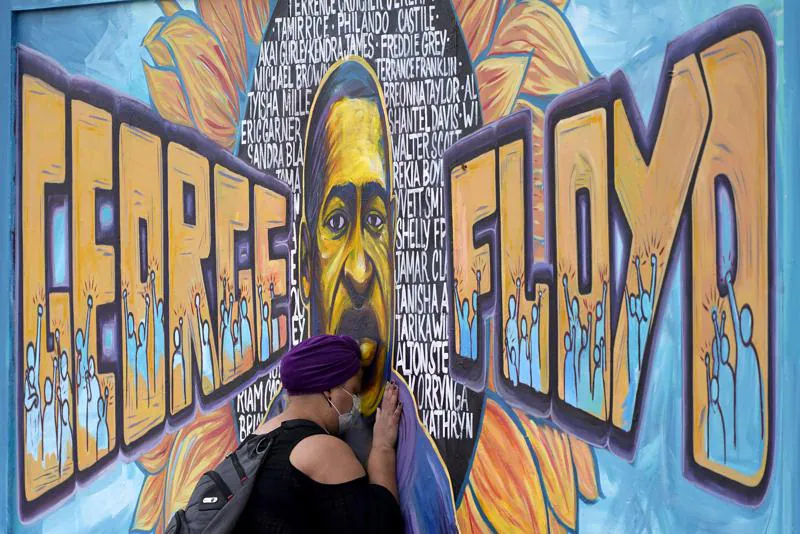
In this April 23, 2021, file photo, Damarra Atkins pays her respects to George Floyd at a mural at George Floyd Square, in Minneapolis. (AP Photo/Julio Cortez, File)
Abbott has not said whether he will posthumously pardon Floyd this year for a 2004 drug arrest in Houston by a former officer whose police work is no longer trusted by prosecutors. Texas’ parole board – stacked with Abbott appointees – unanimously recommended a pardon for Floyd in October.
Since then, the two-term Republican governor, who is up for reelection in 2022, has given no indication of whether he will grant what would be only the second posthumous pardon in Texas history. Floyd, who was Black, spent much of his life in Houston before moving to Minnesota, where his death under the knee of a white police officer last year led to a U.S. reckoning on race and policing.
Read the full article here.
Learn more about changes since George Floyd’s death here.
More Breaking News here.
Comments Are Welcome
Note: We moderate submissions in order to create a space for meaningful dialogue, a space where museum visitors – adults and youth –– can exchange informed, thoughtful, and relevant comments that add value to our exhibits.
Racial slurs, personal attacks, obscenity, profanity, and SHOUTING do not meet the above standard. Such comments are posted in the exhibit Hateful Speech. Commercial promotions, impersonations, and incoherent comments likewise fail to meet our goals, so will not be posted. Submissions longer than 120 words will be shortened.
See our full Comments Policy here.