Beloit’s Black leaders seek to redefine the future for city’s youth
Share
Explore Our Galleries

Breaking News!
Today's news and culture by Black and other reporters in the Black and mainstream media.
Ways to Support ABHM?
by Neil Johnson, GazetteXtra
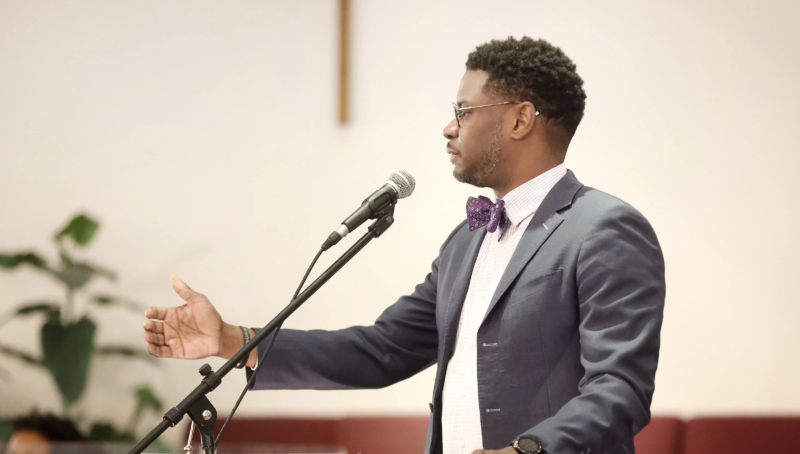
BELOIT — If a community is to change the future its young people could see, it must first redefine how it views itself now.
Beloit Police Chief Andre Sayles, the first-ever Black police chief of this city of 36,000, said Saturday he’s tired of a nickname he believes is meant to demean his town and marginalize it as a place defined by crime. “Be-troit” is a play on words comparing Beloit to Detroit, a metropolis long associated with rampant crime and urban decay.
“The stigma that people have placed on this city is the wrong statement,” he said. “And I’m doing my darndest to correct it.”
Sayle’s words came at a Black History Month breakfast and program Saturday at New Zion Baptist Church on Beloit’s east side. The Beloit cop of 18 years was talking of strategies his officers and the Beloit School District have to disrupt the so-called “cradle to prison pipeline,” the disproportionately high rate of incarceration for Black people in Wisconsin and across the U.S.
Free-speech summer
This summer, Sayles said the school district the police department intend to partner on what he’s calling “Speeches at the Splash Pad,” a series of summertime events at Beloit’s public splash pads. They’ll aim at allowing children of all ages to give speeches that highlight themselves, their identities and how they define their community.
Speeches at the Splash Pad will be open not only to the city’s 15% Black population but Sayles said the events will primarily aim to boost literacy and maintain educational and social ties for local Black students during summer break…
Sayles, one of several Black residents who have emerged as leaders in the top ranks of Beloit’s school district and city hall, and Rock County’s government and judiciary system, spoke during Saturday’s four-hour event. It included breakfast, pleas for justice and fairness, and tears in a social system in which Black people are imprisoned at five times the rate of white people.
Trends
Sayles and others spoke Saturday about hopeful signs in Beloit, including shootings in the city plummeting from more than 100 in 2021 to 28 last year. As of Saturday, it had been 387 days — nearly 13 months — since the last shooting death in Beloit…
Belying the hopeful data is the fact that for inmates at just one prison system for youths, Wisconsin’s Lincoln Hills, incarceration costs $33 million a year—about $427,000 a year per child imprisoned there, Dane County juvenile court Judge Everett Mitchell…
Enjoy the complete article here.
For more Breaking News click here.
For more ABHM galleries click here.
Comments Are Welcome
Note: We moderate submissions in order to create a space for meaningful dialogue, a space where museum visitors – adults and youth –– can exchange informed, thoughtful, and relevant comments that add value to our exhibits.
Racial slurs, personal attacks, obscenity, profanity, and SHOUTING do not meet the above standard. Such comments are posted in the exhibit Hateful Speech. Commercial promotions, impersonations, and incoherent comments likewise fail to meet our goals, so will not be posted. Submissions longer than 120 words will be shortened.
See our full Comments Policy here.