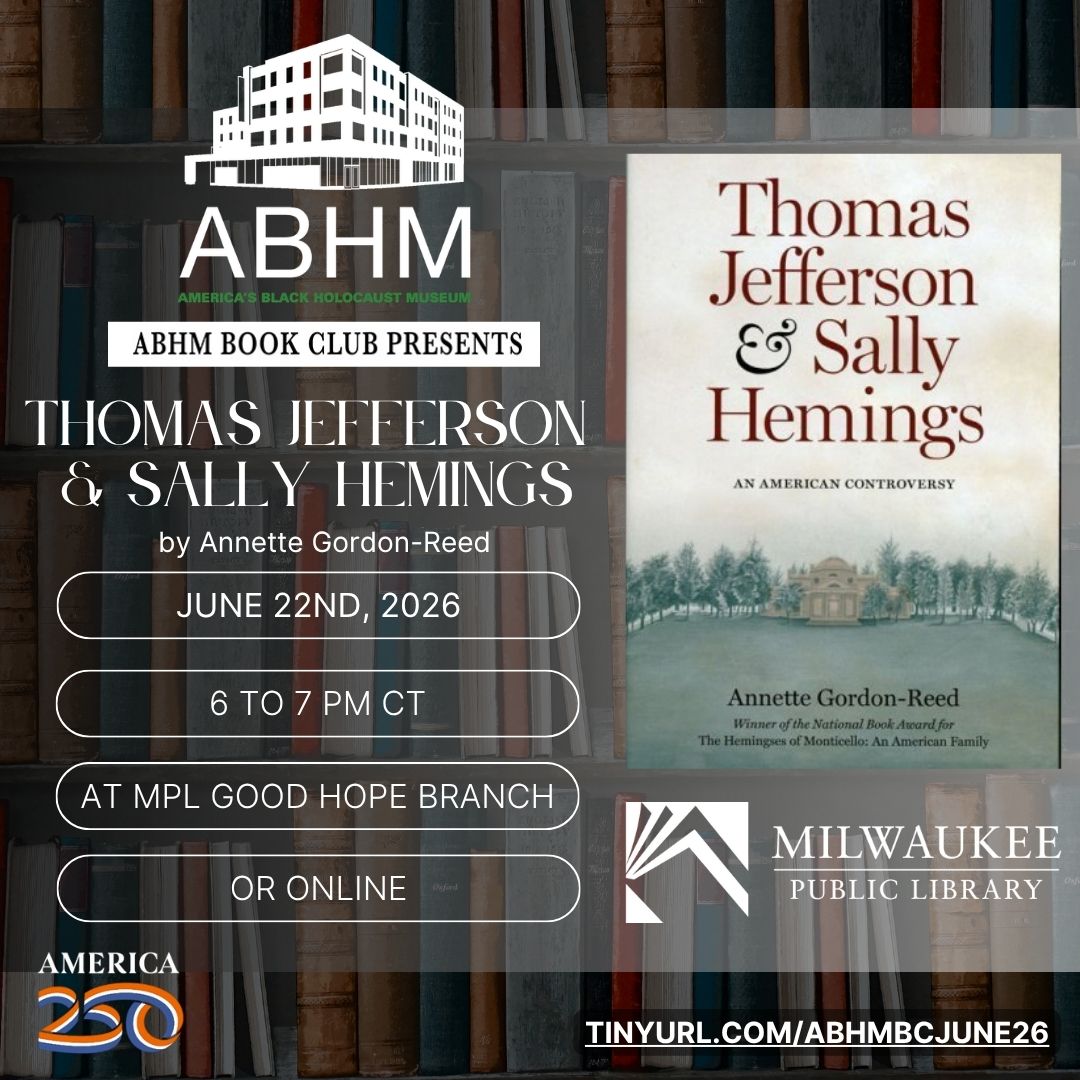
ABHM Book Club: Thomas Jefferson & Sally Hemings by Annette Gordon-Reed
We are pleased to announce ABHM’s June Book of the Month: Thomas Jefferson and Sally Hemings: An American Controversy by Annette Gordon-Reed. We invite you to join us on June 22nd at 6:00 p.m. for a discussion of the book at the Milwaukee Public Library – Good Hope Branch and virtually online. Prior to the book club discussion, guests are invited to attend a panel conversation beginning at 5:00 p.m. Following the discussion, participants are welcome to stay for a community book swap.
History Toward Tomorrow: Why This Matters
In the year 2026 the United States is celebrating its semiquincentennial. At ABHM, we are using this as an opportunity to create programs where we can collectively reflect on our country’s history honestly to build a better, more equitable future. The selections for the ABHM Book Club in 2026 will emphasize historical truth-telling, compelling storytelling, and diverse perspectives on our collective past. We invite participants to consider what they want the country to look like over the next 250 years. What can we learn from visionaries, historians, and thought leaders from the past in how we envision the United States of the future? In the spirit of Dr. Cameron, we invite you to join us on this journey of reflection, healing, and dreaming.
ABOUT THE BOOK
Thomas Jefferson and Sally Hemings: An American Controversy by Annette Gordon-Reed is a landmark work of historical scholarship that reexamines one of the most debated relationships in early American history. Focusing on the long-disputed connection between Thomas Jefferson and Sally Hemings, Gordon-Reed investigates how historians, biographers, and Jefferson’s defenders treated the evidence surrounding the story over nearly two centuries. Rather than simply revisiting old claims, she studies the assumptions that shaped historical interpretation itself, asking why testimony from enslaved people and Black witnesses was often dismissed while contradictory evidence was readily accepted. The book became a major intervention in the field and helped reshape public understanding of Jefferson, slavery, and historical memory.
Through close analysis of documents, timelines, oral histories, and the lives of the Hemings family, Gordon-Reed presents a broader portrait of the contradictions at the center of the American founding. The book explores the tension between liberty and enslavement, public ideals and private realities, and the ways power shaped both lived experience and the writing of history. By placing Sally Hemings and her family back into the narrative, Thomas Jefferson and Sally Hemings challenges readers to confront how national myths are formed and whose voices are included—or excluded—from the historical record. The result is not only a study of two individuals, but a meditation on memory, evidence, and the unfinished work of telling the American story honestly.
ABOUT THE AUTHOR
Annette Gordon-Reed is an American historian, legal scholar, and author whose work transformed the study of early American history and the lives of enslaved people connected to the nation’s founders. Born in Texas in 1958, Gordon-Reed earned a B.A. from Dartmouth College and a J.D. from Harvard Law School before building a career that bridges law, history, and public memory. Her scholarship focuses on slavery, race, historical interpretation, and the complexities of the American founding era. She has held academic appointments at institutions including New York Law School, Rutgers University, and Harvard University, where she serves as a professor of history and legal history. Her groundbreaking first book, Thomas Jefferson and Sally Hemings: An American Controversy (1997), challenged long-standing assumptions in Jefferson scholarship and helped spark renewed examination of the Hemings family story.
Gordon-Reed later expanded this work in The Hemingses of Monticello: An American Family, which received both the Pulitzer Prize for History and the National Book Award. Her other works include Most Blessed of the Patriarchs, On Juneteenth, and African American Studies: An Introduction, all reflecting her commitment to examining the intersections of race, memory, and national identity. Widely recognized as one of the leading interpreters of the American past, Gordon-Reed’s work continues to influence scholarship and public conversations about history, justice, and the meaning of freedom in the United States.