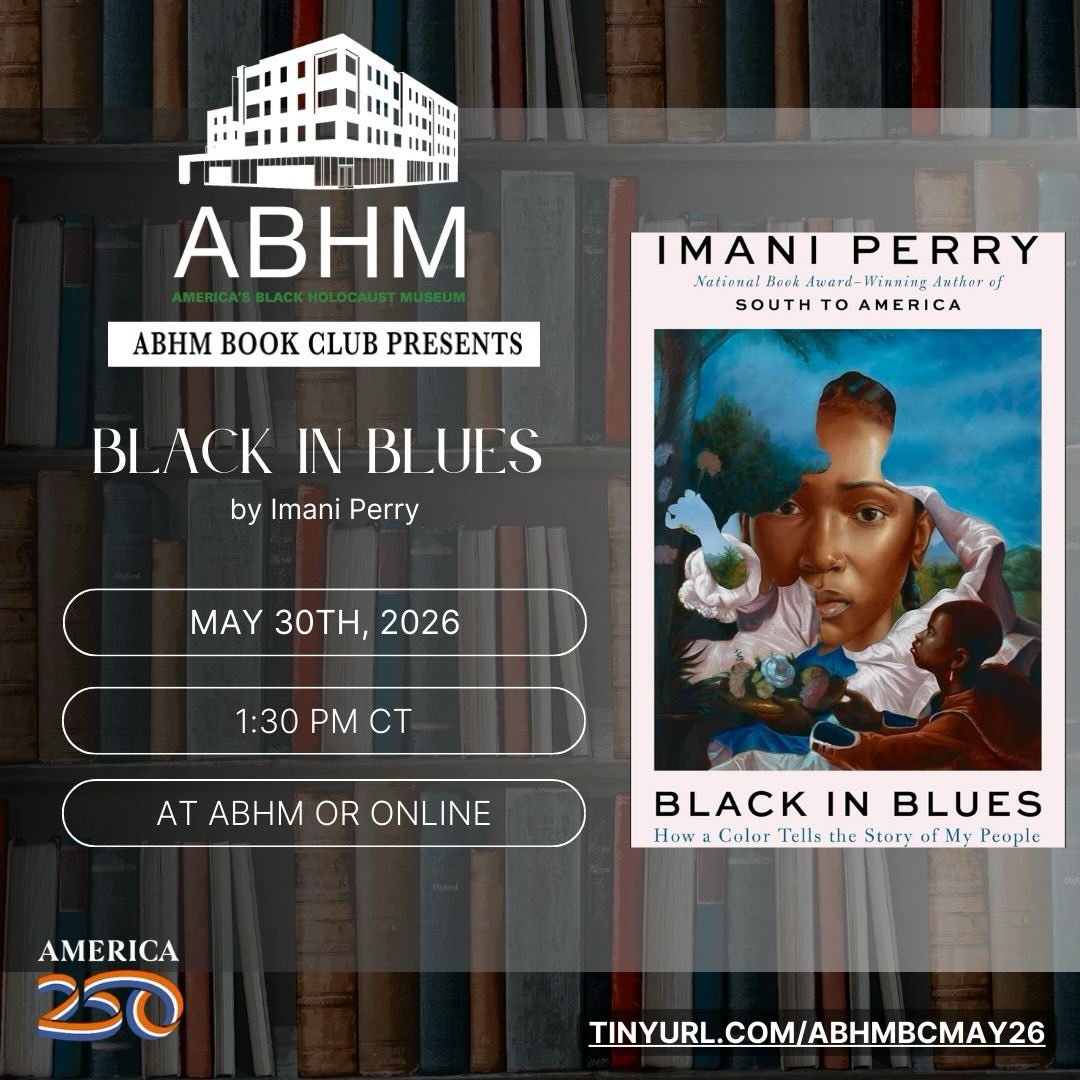
ABHM Book Club: Black In Blues by Imani Perry
We are pleased to announce ABHM’s May’s Book of the Month: Black in Blues: How a Color Tells the Story of My People by Imani Perry. We invite you to join us on May 30th at 1:30 p.m. for a discussion of the book at America’s Black Holocaust Museum or virtually via Zoom.
History Toward Tomorrow: Why This Matters
In the year 2026 the United States is celebrating its semiquincentennial. At ABHM, we are using this as an opportunity to create programs where we can collectively reflect on our country’s history honestly to build a better, more equitable future. The selections for the ABHM Book Club in 2026 will emphasize historical truth-telling, compelling storytelling, and diverse perspectives on our collective past. We invite participants to consider what they want the country to look like over the next 250 years. What can we learn from visionaries, historians, and thought leaders from the past in how we envision the United States of the future? In the spirit of Dr. Cameron, we invite you to join us on this journey of reflection, healing, and dreaming.
ABOUT THE BOOK
Black in Blues: How a Color Tells the Story of My People by Imani Perry is a lyrical and intellectually expansive meditation on the color blue as a through line in African American history and cultural expression. Blending memoir, art criticism, and historical analysis, Perry traces blue from the 17th-century indigo trade—where its cultivation was bound to the violence of the transatlantic slave economy—to its enduring symbolic power in Black life. She explores how blue signifies both the sorrow embedded in the “blues” tradition and a profound aesthetic of elegance, depth, and spiritual resonance. In Perry’s hands, blue becomes not merely a color but a language—one that carries memory, grief, creativity, and survival across centuries.
Moving fluidly between history and contemporary culture, Perry reflects on blue as it appears in music, fashion, visual art, and everyday life. She considers its presence in the work of artists such as Lorna Simpson and Firelei Báez, examining how their uses of blue evoke migration, ancestry, femininity, and power. Interwoven with personal reflection, the book treats “blue-black” as both a literal and conceptual marker—an evolving expression of identity shaped by beauty and brutality alike. Ultimately, Black in Blues presents the color as a strategy of interpretation and a vessel of collective meaning, illuminating how something as seemingly simple as hue can hold the layered story of a people.
Comments Are Welcome
Note: We moderate submissions in order to create a space for meaningful dialogue, a space where museum visitors – adults and youth –– can exchange informed, thoughtful, and relevant comments that add value to our exhibits.
Racial slurs, personal attacks, obscenity, profanity, and SHOUTING do not meet the above standard. Such comments are posted in the exhibit Hateful Speech. Commercial promotions, impersonations, and incoherent comments likewise fail to meet our goals, so will not be posted. Submissions longer than 120 words will be shortened.
See our full Comments Policy here.